Delivered by FeedBurner

New Answers in your Inbox

Send Free SMS and win iPod touch every month

Hello Friends,

Just found a site from where you can send free SMS to any network in India. It is YouMint.com.

And you can also win an iPod touch every month just by inviting your friends. Join now

http://www.youmint.com/network-yiam/

BCA MCA Forum opened again

After getting huge spam attack at our BCA MCA forum, registration was disabled temporally. But now registration is opened again. If you face any problem at time of registration please post here.

Also, I want to improve our forum, so requesting you to post your suggestion here: http://www.ignoubcamca.com/forum/viewtopic.php?p=247

Thanks

Online Examination Form: Last Date is extended till 15th October

Last Date for filling Online Examination Form is extended till 15th October,2007 without late fee.

For instructions please visit IGNOUs official site: http://examform.ignou.ac.in/defaultnew.htm

Sparse Matrix

MCA, CS-04 2001 (June)
Q.1 (a). What is sparse matrix? Give example. [12]

Ans. Matrices with a relatively high proportion of zero entries are called sparse matrices. Two general types of n-square sparse matrices which will occur in various applications are pictured in Figure.

The first matrix, all entries above the main diagonal are zero or equivalent, where none-zero entries can only occur on or below the main diagonal is called a lower triangular matrix.

The second matrix, where non-zero entries can only occur on the diagonal or on elements immediately above or below the diagonal is called a tridiagonal matrix.
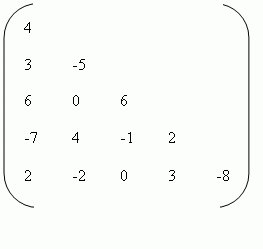

Fig: 1
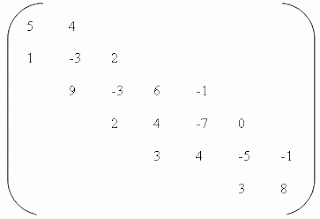

Fig:2

One may save space by storing only those entries which may be non-zero.

In space array indices are permitted for a larger set, but those values actually added to the array consume memory. Thus the program can ask for Sparse Array [5] or Sparse Array [200], but the memory be allocated for only a small number of entries.

Example: Suppose we want to place in memory the triangular array B in first Figure. We store only those entries of B in linear array C as indicated by arrows i.e. C[1]=b11, C[2]=b21, C[3]=b22, C[4]=b41, ….

C will contain only 1+2+3+ …+ n = n(n+1)/2 elements, which is about half as many elements as a two-dimensional h x n array.

L is integer in terms of J and K, Where C[L]=bjk, L represents the number of elements in the list upto and including bjk. There are

1+2+3+…+(J-1)=J(J-1)/2 elements in rows above bjk, K elements in row J upto and including bjk. Accordingly, L = J(J-1)/2+K yields the index that accesses the value bjk from linear array C.

Admission Open for January 2008 Session

IGNOU has initiated admissions for various Academic Programmes Including BCA and MCA for the session January 2008.

Students who are will to take admission in BCA/MCA or any other course, can obtained The Prospectus from all the regional Centres of IGNOU or from Registrar (SR&E), Maidan Garhi, New Delhi-110068, in person, on payment of Rs. 100/- in cash or through DD/IPO of Rs. 150/- drawn in favour of IGNOU payable at New Delhi/ at the city of the Regional Centre/ Partner Institution concerned. Application form can also be downloaded from the website at http://www.ignou.ac.in and submitted along with DD for Rs. 100/- in addition to the programme fee.

Submission of forms with fee at the concerned Regional Centre is 12th November 2007.

BCA Question Paper of 2006

We are updating our site "IGNOU BCA MCA". We are in process of adding few more question papers. We are starting with adding BCA question papers of year 2006. More question paper will be added in future.

We are also adding the IGNOU BCA questions in our BCA forum where you can post answers if you know and exchange your knowledge with others. We are requesting you all to share your knowledge and post what you know.

Kruskal Algorithm

CS62, December, 2001
Question 4(b): Write Kruskal's Algorithm.

Answer: Kruskal's Algorithm enables us to find a minimal spanning tree T of a connected weighted graph G where n vertices. (In which case T must have n-1 edge.

Steps of Kruskal's Algorithm: The input is a connected weighted graph G wigh n vertices.

Step 1: Arrange the edges of G in order of increasing weights.
Step 2: Starting only with vertices of G and processing sequentially, add each edge which does not result in a cycle until n-1 edges are added.
Step 3: Exit

The algorithm is easily executed when graph G is small.

Adding two integers-CS 62December-1999

Q.1.(a) Write a routine in C for adding two integers represented by doubly linked lists.
Answer: NODEPTR addint (NODPTR p, NODEPTR q)
{
/* check if integers are of like sign */
if(p->info * q ->info >0)
return (addsame(p,q));
/* check which has a larger absolute value */
if(compabs(p,q)>0)
return (addiff(p,q));
else
return (addiff(q,p));
}

Binary Search Tree [CS62 june 2001]

Queation: 1.(c) Define binary search tree. Write a function in C to creat a binary search tree.

Answer:
A binary search has porperty that all elements in the left subtree of a node n are less than the contents of n and alll elements in the sight subtree of n are greater than or equal to the contents of n.
If a binary search tree is traversed in inorder (left, root, sight) and the contents of each node are printed as the node is visited, the numbers as the node is visited, the numbers are printed in ascending order.

q=null;
p=tree;
while(p!=null){
if (key ==k(p))
return(p);
q=p;
if(key < key(p))
p=left(p);
else
p=right(p);
}
v=maketree(rec,key);
if(q==null)
tree=v;
else
if(key < k(q))
left(q)=v;
else
right(q)=v;
return(v);


IGNOU BCA MCA

Difference- Singly and Doubly Linked Circullar List [CS62 june 2001]

Queastion: 2(b) List the difference between a Singly Linked Circular List and Doubly Linked Circular List. List the advantages of each list.

Answer: In single linked circular list one cannot traverse a list backward, nor can a node be deleted from a circularly linked list, given only a pointer to that node. Whereas in double linked list each node in such a list contains two pointers, one to its predecessores and another its successor. Deleting a given node is possible in double linked list whereas it is not possible in simple linked lists.

Binary Search Tree -CS62 june 2001

Queation: 1.(c): Define binary search tree. Write a function in C to creat a binary search tree.
Answer: A binary search has porperty that all elements in the left subtree of a node n are less than the contents of n and alll elements in the sight subtree of n are greater than or equal to the contents of n.
If a binary search tree is traversed in inorder (left, root, sight) and the contents of each node are printed as the node is visited, the numbers as the node is visited, the numbers are printed in ascending order.
q=null;
p=tree;
while(p!=null){
if (key==k(p))
return(p);
q=p;
if(key
p=left(p);
else
p=right(p);
}
v=maketree(rec,key);
if(q==null)
tree=v;
else
if(key
left(q)=v;
else
right(q)=v;
return(v);

CS62 2001 December 4 (ii) algorithm to implement breadth first search

Question: Write an algorithm / Program to implement breadth first search and also describe the program/algorithm in terms of data structure and its functioning. [CS62, 2001 December, Question 4(ii) ]

Answer:
The algorithm to implement breadth first search is listed below:
Step 1: Initialization of vertices by assigning the vaule 1 to dummy.
Step 2: Place the beginning vertix in Z and set it to halt by assigning 0 to dummy
Step 3: Loop through step 5 until Z becomes NULL.
Step 4: Delete the front vertex of Z. Manipulate the front vertex and set to active state by assigning -1 to dummy.
Step 5: Towards the back of Z, add all the active neighbors of the front vertex y assigning 1 to Dummy, and set them to halt by again assigning 0 to Dummy.
Step 6: Quit

CS62 Jan 2001 3a algorithm of iteractive version of pre-order traversal

Q. Write an algorithm of iteractive version of pre-order traversal.

Ans:
The recursive algorithm of preorder traversing is listed below:
Preorder (Node)

Step1: [Looop through step no. 3]
if Node is not equal to NULL value
Display Inforamtion [Node]
Step2: Make a Call to Preorder(LeftChild [Node])
Step3: Make a Call to Preorder(RightChild [Node])
Step4: Quit

IGNOU MCA Forum

Here is a new forum for IGOU MCA Students to discuss on July 2006 assignment (Old and New Syllabus).Discuss your assignments, questions, problem with hundreds on online students.

Doing Business in India

This post is for those who wants the following information:

  • Business in India,
  • Business opportunities in India,
  • Business schools in India,
  • The Indian business culture.
  • Doing Business in India

Click here for complete information on Doing Business in India

CS-62 JUNE 2003 QNO 6(a)

Q.Write a recursive algorithm to implement Quick Sort.

Ans. The Quick Sort can be implemeted efficiently using recursion. The Base case may be when low is greater than or equal to high.

The function/algo is as follows:

quick(a, low, high)
int a[], low, high
{
if (low>=high)
return;
partition (a, low, high, pos);
quick(a.low, pos-1);
quick(a.pos_1, high);
}

New website for IGNOU BCA MCA student

New website for IGNOU BCA MCA student

MCA-BCA-IGNOU

CS-62 JUNE 2003 QNO 3(c)

3 (c) What is an AVL tree? How does it differ from a Binary Tree?
Answer

A Tree is called AVL tree (Balanced Binary tree) if each node possesses one of the following properties:
(i) A node is called left heavy, if the longest path in its left subtree is one longer then the longest past of its right subtree.
(ii) A node is called right heavy, if the longest part in the right subtree is one longer than the longest path in its left subtree.
(iii) a node is called balanced if the longest paths in both the right and the left subtrees are equal.

Binary tree: A tree is a binary tree if each node of it can have at the most two branches. In other words we can say that if every node of a tree can have at most degree two, then its is called binary tree. In a binary tree left and right subtrees distinguish subtrees of a node.

An AVL tree is a balanced tree, but binary tree can be unbalanced also.

CS-62 JUNE 2003 QNO 3(a)

3(a) Write the postfix form of the following expresstion:
(i) (C X D) ÷ (a-b)
(ii) C X D ÷ a – b

Answer (i) :
cd* ÷ (ab-)
cd*ab-÷

Answer (ii) :
c*da÷- b
cda÷*- b
cda÷*b-

CS-62 JUNE 2003 QNO 3(a)

3(a) Write the postfix form of the following expresstion:
(i) (C X D) ÷ (a-b)
(ii) C X D ÷ a – b

Answer (i) :
cd* ÷ (ab-)
cd*ab-÷

Answer (ii) :
c*da÷- b
cda÷*- b
cda÷*b-